LOCAL-FIRST · RUST CORE · MIT

Your notes, your models,
one understandable agent.

Restork connects local Markdown with cloud or local models, then keeps context, tools, writes, and recovery behind one reviewable Core.

No provider, Vault, weather, calendar, or location is enabled on first launch.

RESTORK CORE · 127.0.0.1
Local knowledge and four memory layers pass through the governed Restork Core before approved model or tool access.

ONE CORE, THREE WAYS TO MOVE

Work the way a real day unfolds.

R

Research

Compare claims, keep evidence attached, and review a cited Markdown note before saving it.

S

Study

Build prerequisites, practice without answer leakage, and revisit what you actually missed.

W

Work

Turn a bounded goal into a plan, report, presentation, or redacted handoff with recoverable artifacts.

THE PRODUCT, NOT A MOCKUP

Watch a governed run.

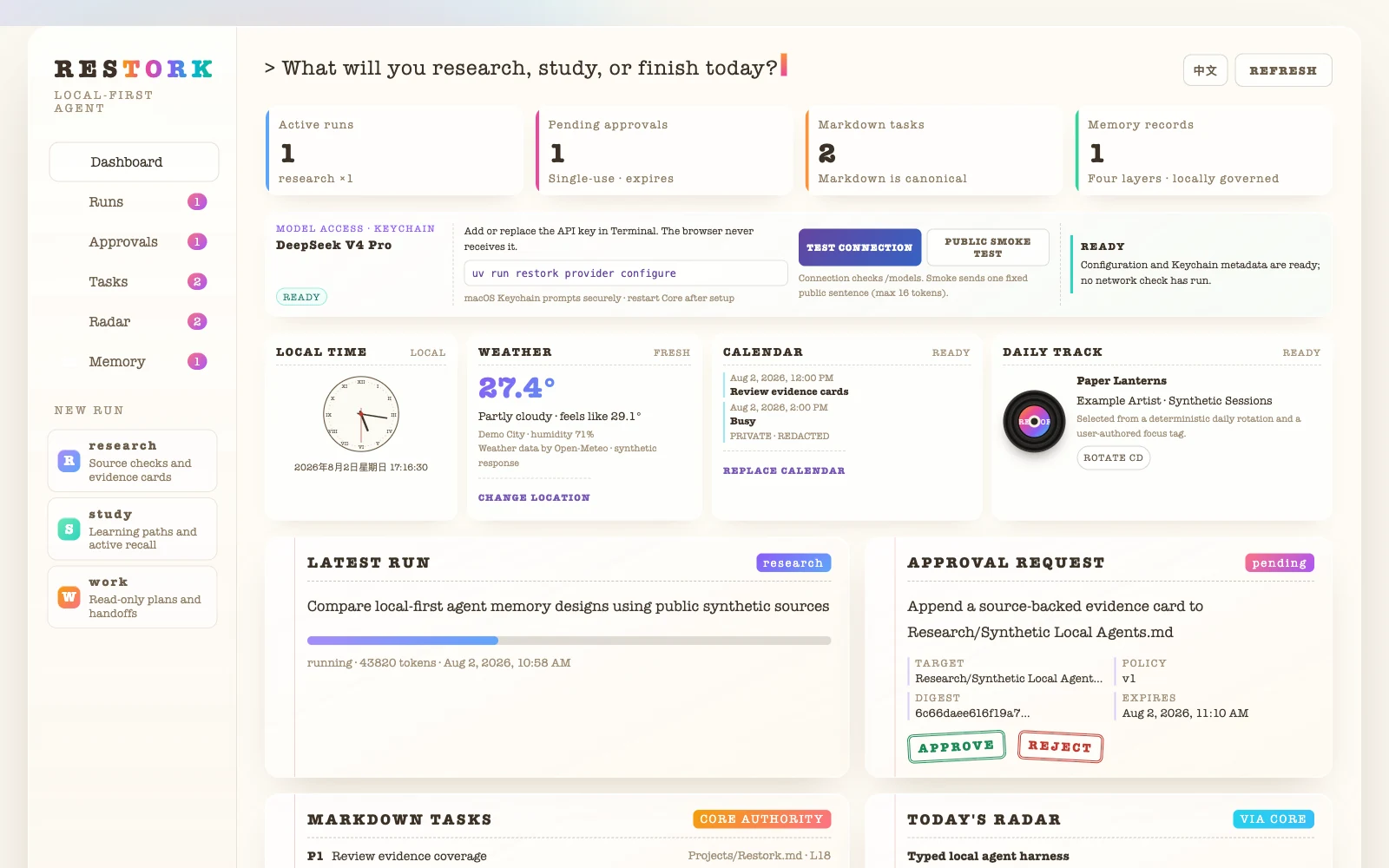
This public recording uses synthetic data and makes no live model request.

Restork Dashboard with runs, approvals, daily context, tasks, and memory using synthetic public data.
01

Markdown stays ordinary

Use an existing Obsidian Vault or a separate folder. Restork does not turn your notes into a proprietary database.

02

Reasoning is a real setting

Choose DeepSeek, GLM, Kimi, Qwen, Ollama, OpenRouter, or a compatible endpoint. Only supported intensity levels appear.

03

Effects are reviewable

Typed policy, preview hashes, one-use approvals, event history, and file checkpoints live outside prompt text.

04

Desktop lifecycle is owned

The Rust shell selects a port, supervises Core, checks heartbeats, and terminates its complete process tree.

FIVE-MINUTE SOURCE START

Explore first. Connect things later.

git clone https://github.com/Totoro-qaq/restork.git
cd restork
./scripts/quickstart.sh

Open the printed loopback URL and enter the one-time pairing code. The offline path needs no API key and reads no Vault.